
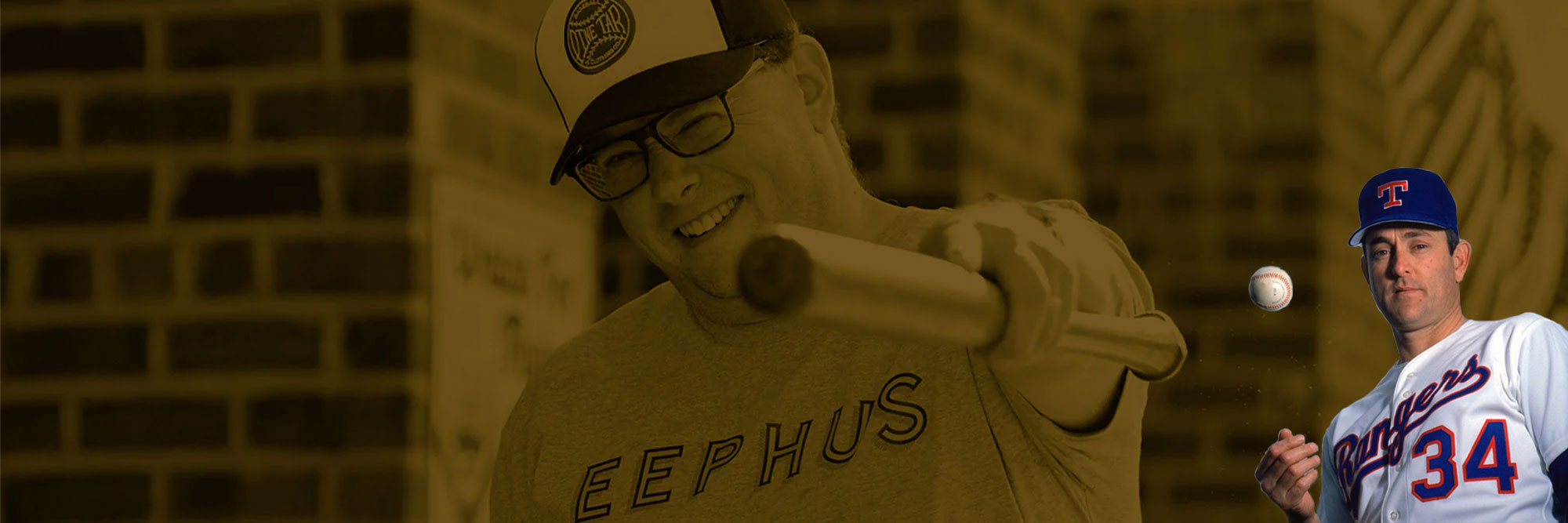
Nolan Ryan, Junk Wax, And What Grit Really Looks Like
When you grow up in the 80s and 90s loving baseball, there are certain names that just feel bigger than the game itself. For me, one of those names will always be Nolan Ryan. He wasn’t just a pitcher with a big fastball and a stack of records; he was a living example of what it means to play with grit and love for the game – the exact heartbeat behind Pine Tar Clothing.
Why Nolan Ryan Fits The Pine Tar DNA
At Pine Tar, we talk a lot about celebrating the hustle and heart of baseball – respecting players and fans who show up with grit and genuine love, whether they’re on the field or in the stands. Nolan Ryan checks every one of those boxes.
He pitched 27 seasons in the big leagues, starting with the Mets and then moving through the Angels, Astros, and Rangers, hanging it up after the 1993 season. Along the way he racked up a record 5,714 career strikeouts, seven no-hitters, and more 300-strikeout seasons than most pitchers can even dream about. Those numbers are wild, but the way he carried himself is what sticks with me most.
Power, Pain, And Refusing To Back Down
As a kid, I remember learning that Nolan Ryan was one of the first guys to consistently throw over 100 miles an hour. At a time when seeing 90 on the radar gun already felt insane, he was living at a level that today is still rare even in a league full of flamethrowers.
But the fastball is only half the story. He paired that heat with a true 12–6 curveball that dropped straight off the table, the kind of pitch that buckled knees and left hitters frozen in the box. There are countless clips of hitters just giving up mid-swing as that curve snapped in, and you can almost feel them thinking: “What am I supposed to do with that?”
Then there’s the toughness.
Two moments always come to mind:
-
The Robin Ventura incident: Ventura got plunked, decided to charge the mound, and quickly learned that going after the “old guy” was a mistake. Ryan put him in a headlock and handled his business, then just went right back to pitching.
-
The Bo Jackson comebacker: Bo smoked a ball back up the middle that caught Ryan in the face, opening up his lip and staining his white jersey with blood. Instead of coming out, he stayed in the game, blood on his shoulder, lip still bleeding, and kept dealing.
Those images – the headlock, the blood-soaked jersey – are pure “hustle and heart” in motion. They’re the kind of moments that go way beyond stats and into the realm of legend.
27 Years Of Abuse On An Arm
It’s one thing to make it to the big leagues; it’s another thing entirely to stay there for nearly three decades. As a pitcher, that means thousands of high-intent throws, constant stress on your shoulder and elbow, and every opportunity for your body to finally say “enough.”
Yet Ryan kept going. He didn’t have a long list of major injuries that derailed his career, and he still managed to throw that hard for that long. By the time he was done, his career record sat at 324–292 with a 3.19 ERA – not the cartoonish win–loss line you might expect, but proof of a guy who took the ball, attacked hitters, and lived in the zone for 27 seasons. Eleven league strikeout titles, multiple ERA crowns, and his number retired by the Angels, Astros, and Rangers tell you how much respect he earned everywhere he went.
That’s a huge part of why he resonates with me: he wasn’t chasing perfect optics, he was just relentlessly doing the work.
A Kid In The Metrodome Nosebleeds
My connection to Nolan Ryan isn’t just through baseball-reference pages or documentaries; it’s tied to a specific memory in the nosebleeds of the Metrodome. I got to see him pitch once in person against the Twins. I was way up high, but I still remember looking down at the bullpen as he warmed up, watching that ball pop the catcher’s mitt over and over.
Even from that distance, it felt different. The sound, the tempo, the way the catcher’s glove snapped – it all made a huge impression on me as a young fan. Seeing a guy you’ve collected on cardboard suddenly become real in front of you has a way of cementing them in your personal baseball story.
Collecting Nolan: Junk Wax, Grails, And Lessons
If you’ve seen the backdrop in my videos or listened to the Pine Tar Podcast, you know I’m a baseball card guy, especially when it comes to history. Nolan Ryan sits right in the middle of that collection.
A few highlights:
-
A reproduction of his famous rookie card with Jerry Koosman – not the real deal, but close enough for now.
-
A warning label disguised as a story: I once bought what I thought was a gold-pen autographed version online for about twenty bucks. Turns out the “signature” was embossed into the card from the factory. Lesson learned: always check your autographs.
-
A 1971 Topps Nolan Ryan that I hunted down and finally grabbed for around forty dollars. It’s a beautiful card, one of my favorites, and it captures him in that gritty early-70s look that just feels right for who he was.
-
A graded Score card from the early 90s junk wax era commemorating his 5,000th strikeout. The era might be called “junk wax” because of how overprinted it was, but for collectors who grew up then, those cards still carry real emotional weight.
-
An Upper Deck art card from a Nolan Ryan set, with a painted illustration that captures a kid learning to throw that famous 12–6 curveball.
These cards aren’t just pieces of cardboard; they’re little time capsules of what made Ryan special – the milestones, the aura, and the way the hobby exploded when he was still dealing.
From Alvin, Texas To Cooperstown
If you’ve watched the Nolan Ryan documentary, you know the story: a kid from a small town in Texas, Alvin, thrown into pro ball after high school, wild early on, gradually learning to harness that insane arm. He broke in with the Mets in the late 60s, contributed to the 1969 Miracle Mets, and then really took off after moving on to the Angels and beyond.
Years later, I had the chance to visit Cooperstown and see his Hall of Fame plaque and memorabilia in person. He was inducted in 1999 as a first-ballot Hall of Famer, and standing there, looking at his stuff surrounded by the game’s all-time greats, it drove home just how big an impact he had.
It also reminded me why guys like him matter to brands like Pine Tar. He’s not just a stat line; he’s a symbol of what happens when you show up, do the work, and refuse to give in.
When Baseball Legends Leak Into Real Life
People sometimes ask if my oldest son, Nolan, is named after Nolan Ryan. The honest answer is that I’ve always just liked the name, and my son ended up being a pitcher, which feels fitting. But if I’m being real, I’m sure that somewhere in the back of my mind, that connection to Nolan Ryan was there.
That’s the thing about players like him: they sneak into your life in ways you don’t always notice at first. They shape how you see the game, what you think toughness looks like, and what you believe “loving the game” actually means.
For Pine Tar, Nolan Ryan is one of those north stars. He played with grit. He played with love. He took his lumps, wore his scars, and kept taking the ball.
Here’s to you, Nolan Ryan – and to every player, past and present, who throws hard, digs deep, and reminds us why we fell in love with this game in the first place.
If you’ve got a favorite Nolan memory or a card you still treasure from the junk wax days, I’d love to hear about it. Drop it in the comments or send a message – this brand lives for stories like that.

Written by Jeffrey Ruprecht


Leave a comment
This site is protected by hCaptcha and the hCaptcha Privacy Policy and Terms of Service apply.